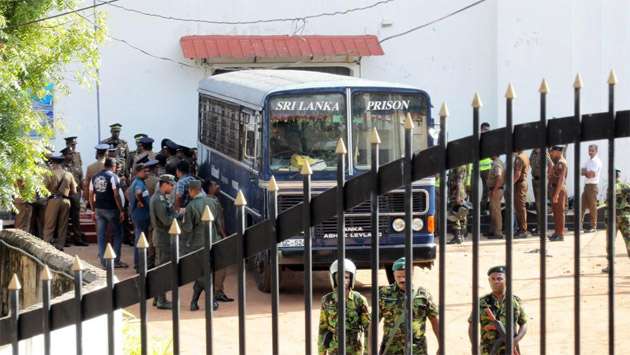
July 08 – A violent unrest that erupted at the Negombo Prison on July 5 and 6 has resulted in one of the deadliest prison incidents recorded in Sri Lanka, leaving 27 people dead and 104 others injured.
According to prison authorities, the unrest initially broke out on July 5 following a confrontation between two groups of inmates, many of whom were reportedly being held in connection with drug-related offences. Thirty-five inmates injured during the initial clash were admitted to hospital, while two inmates died. By the evening, authorities stated that the situation had been brought under control, with inmates returned to their respective wards and routine prison activities resumed.
However, tensions escalated again on the morning of July 6 when prison officers entered the facility to facilitate court proceedings. Prison officials stated that some inmates were reportedly under the influence of drugs and experiencing a state of delirium, leading to another confrontation. Officers who attempted to control the situation were also attacked during the unrest.
According to authorities, a group of inmates moved towards the main entrance of the prison, raising concerns that they could break through the security barriers and escape. Security personnel stated that firearms were used as a measure to protect prison officers and prevent a possible prison breakout.
The Police Media Spokesperson’s Office confirmed that, by the morning of July 7, the death toll had risen to 27. Of those killed, 20 were inmates and seven were prison officers. Another 104 individuals, including inmates and officers, sustained injuries and were receiving treatment at the Negombo District General Hospital and the National Hospital of Sri Lanka.
Prison Media Spokesperson A.C. Gajanayake identified increased restrictions on drug-related activities within prisons and disputes among inmates as possible contributing factors behind the incident. He also noted that tensions may have arisen due to certain inmates providing information about drug trafficking activities to prison authorities. However, he emphasized that a definitive conclusion could only be reached following the completion of investigations.
Questions have also emerged regarding whether intelligence information about a possible confrontation had been received prior to the incident. While opposition parliamentarians alleged that prior warnings had been ignored, Commissioner General of Prisons Prasad Hemantha Kumara stated that no specific intelligence information regarding such an incident had been received.
During the unrest, several female inmates raised concerns over the treatment of prisoners suffering from dengue, alleging that some deaths had occurred due to inadequate medical care. The Department of Prisons Sri Lanka and the government rejected these claims, stating that dengue patients had received necessary treatment and that no deaths linked to dengue had been recorded.
The incident has once again drawn attention to the long-standing issue of overcrowding within Sri Lanka’s prison system. Although the combined capacity of the country’s 36 prisons is approximately 10,500 inmates, official data indicates that the prison population had increased to 41,257 by July 5. Negombo Prison alone was reportedly holding nearly 2,400 inmates, far exceeding its intended capacity.
Following the unrest, nearly 1,000 inmates were transferred to several other prisons, including Angunakolapelessa Prison, Boossa Prison, Dumbara, Anuradhapura, Polonnaruwa and Kuruwita prisons, as part of measures to restore security.
The names of deceased and injured inmates have been displayed at the Negombo District General Hospital and the prison premises. Authorities have also issued necessary permissions for relatives to visit injured inmates receiving treatment.
The Criminal Investigation Department Sri Lanka has commenced investigations into the incident, focusing on how weapons entered the prison, the circumstances that triggered the clashes, and the individuals responsible for the deaths and injuries.
The incident has intensified calls for urgent reforms within Sri Lanka’s prison system, including improved security mechanisms, better management of overcrowding, and stronger safeguards for the rights and dignity of persons deprived of liberty.
Addressing Parliament, Justice Minister Harshana Nanayakkara stated that the government is taking steps to introduce reforms such as legal provisions for house arrest, electronic monitoring systems, and the recruitment of additional prison officers. He acknowledged that addressing decades-old structural challenges within the prison system would require time and sustained efforts.
The tragic events at Negombo Prison highlight the continuing need for comprehensive prison reforms, effective oversight mechanisms, and accountability to ensure the protection of human rights within places of detention.
For further information:
URGENT SITUATION REPORT_ Date of Report_ 8th July 2026 Time of Compilation_ 08_30 hrs (1)